Materials · August 27, 2026 · 4 min read
Drip Edge: The Smallest Piece of Your Roof Decides Where the Water Goes
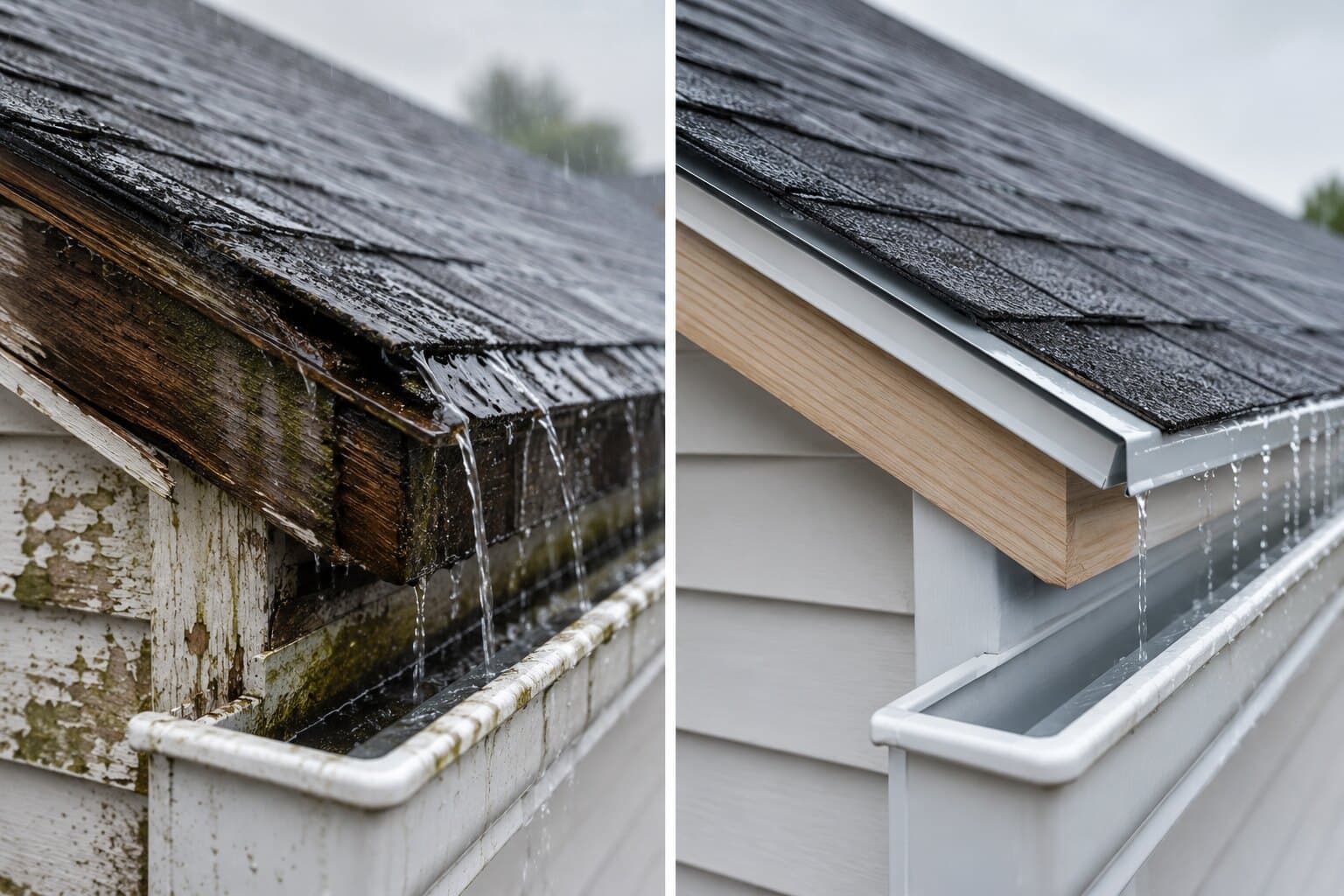
Nobody picks a roofer because of the drip edge. It's a narrow strip of metal along the roof edge, and once the shingles are on you can barely see it.
But it decides where every gallon leaving your roof ends up — in the gutter, or behind it and into the wood.
Here's what it does and how to check your own roof from the ground.
What it is
An L- or T-shaped strip of metal — aluminum, galvanized steel, sometimes copper — installed along the roof deck before the shingles go down.
One flange lies flat on the deck, under the roofing. The other turns down past the fascia and kicks water out, away from the wood.
It runs along two edges, and the names matter when you're talking to a roofer:
- Eaves — the low horizontal edges where the gutters hang
- Rakes — the sloped edges at the gable ends
Both need it.
Why water runs backwards without it
Water doesn't fall off the end of a roof. It clings.
Surface tension pulls the last inch of runoff around the shingle edge and back underneath — the same reason coffee runs down the side of a mug instead of dropping off the rim. A drip edge breaks that contact and forces the water to let go.
On a house without one, that water finds the plywood edge, the fascia and the soffit. Every time it rains.
What we find on those tear-offs:
- Soft, dark deck edges — the first two inches of plywood crumbling under the shingles
- Rotted fascia behind the gutter, which is what makes gutters sag and pull away
- Blistered paint on the fascia, soffit, and sometimes the siding below
- Wind-driven rain pushed up under the shingle edge during Carolina thunderstorms
- Gaps at the edge that wasps, bees and squirrels treat as a doorway
The layering order at the edge
The order of drip edge and underlayment is different at the two edges, and it's easy to assume it's the same at both.
At the eaves: drip edge first, directly on the deck. Underlayment laps over the top of it.
At the rakes: underlayment first, drip edge over the top.
The reason is where the water is travelling. On the eave, water that gets under the shingles runs on top of the underlayment, downhill, and needs to land on the metal to reach the gutter. If the underlayment goes down first, that water runs off the felt and behind the metal — into the fascia.
At the rake there's no downhill flow to catch. The threat is wind-driven rain pushing sideways under the edge, so the metal goes on top to shed it back onto the underlayment.
Same two materials, opposite order, and on the eave the order is what makes the detail work.
Check your own roof in two minutes
No ladder needed. Stand back from the house on a clear day, ideally with binoculars or your phone's zoom.
- Look for a thin, continuous line of metal along the bottom edge, tucked under the shingles and reaching over the back of the gutter. Shingles ending straight into open air above the fascia usually means no drip edge.
- Check the gable edges too. They're easy to overlook from the ground because the angle hides them.
- Look at the fascia paint under the gutters. Streaks, bubbling and dark patches mean water has been running where it shouldn't.
- After a heavy rain, look for a wet line on the siding directly under the roof edge.
If you're filing an insurance claim
Drip edge is almost always included in the carrier's scope on an approved replacement, so it's already part of what's being paid for.
It's worth asking for photos of the edges taken before the shingles went on. Progress photos of the edge details are easy to take and they document a part of the roof nobody can see afterward.
The short version
Drip edge is one of the least expensive components on your roof, and it protects the parts that cost the most to fix — the deck, the fascia, the soffit, and whatever is behind them.
Not sure whether your roof has one? We inspect roofs across Charlotte and both Carolinas for free, and you get photos of what we actually find — including the edges.
Questions about your own roof?
Free inspection, honest answer, financing available — schedule here or call (800) 698-3888.